an open letter to Average Jose
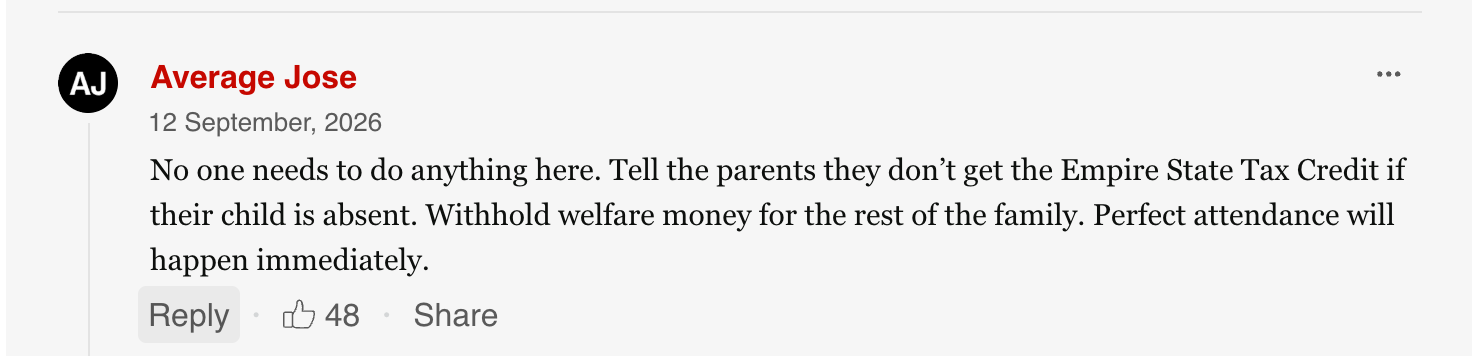
A comment on the NY Post's coverage of the new school avoidance liaison policy got 48 likes last month. It suggested that withholding the Empire State Tax Credit from parents of absent children, and cutting welfare payments to their families, would produce perfect attendance immediately.
48 people liked it. I had to put my phone down.
Not because it surprised me — comments sections have their own ecosystem — but because the same logic turns up everywhere, in less public forms. From relatives. From neighbors. From the occasional school administrator who hasn't encountered this before and has decided they understand it anyway. These comments cause real harm when it shapes how families and schools respond to school avoidance.
What school avoidance actually is
School avoidance, or emotionally based school avoidance as it's known in the clinical literature, is not truancy. It is not a choice. It is a condition in which severe anxiety, depression, or other mental health and neurodevelopmental factors make school attendance genuinely impossible, in the same way that a panic disorder makes certain situations genuinely impossible for adults who have them. The child is not deciding not to go. The child's nervous system is preventing her from going, and the distinction matters enormously, both for the child and for what actually helps.
Between 1% and 15% of children are school avoidant, according to researchers' estimates. Many of them have diagnoses of anxiety, ADHD, depression, autism, or combinations of these. They are not absent because their parents failed to apply sufficient financial pressure. They are absent because they are dealing with something that financial pressure cannot reach.
What families have actually spent
The Empire State Tax Credit, which Average Jose proposed withholding, is worth up to $330 per child per year.
I'll put that figure next to some others.
Weekly therapy with a private therapist specialising in anxiety and school avoidance: $150 to $250 per session, which is $7,800 to $13,000 per year before insurance, which often covers very little of it
A neuropsychological evaluation to understand what you're dealing with: $3,000 to $6,000, rarely covered by insurance
An educational advocate to help navigate IEP and 504 processes: $100 to $300 per hour
That's before the cost of alternative education options, tutors, the lost income from a parent who can no longer work full time because the morning requires two hours of management, the medication, the co-pays, the driving, and the sick days taken to sit in school car parks at 7am.
Most families navigating school avoidance have spent more, often significantly more, than $330 trying to get their child back into school. I would gladly pay the government the Empire State Tax Credit ten times over if it meant my child was happy in school. Every parent in this situation would.
In fact, I'd like to make Average Jose a counter-offer. I will gladly give him the $330 to come to my house one morning and convince my daughter to go to school. He is welcome to keep the change.
What punitive approaches actually do
The research on this is consistent. Coercive approaches to school avoidance — forcing attendance, punishing absence, applying pressure without addressing the underlying anxiety — do not work and frequently make things worse. Some schools have responded to school avoidance by blaming parents and refusing to support students who weren't physically in the building. The outcomes for those children are not good, which is part of why there is now a class action lawsuit and a new citywide policy.
What works is the opposite: a gradual, supported return that addresses the anxiety rather than overriding it, combined with accommodation and a school environment that understands what it is actually dealing with. This takes time, professional support, and a willingness to treat school avoidance as the medical and psychological issue it is. It does not take a reduced tax credit. Anxiety is, to its considerable inconvenience, largely indifferent to financial incentives.
NYC public schools have long lacked clear guidance on school avoidance, and without systemwide guidance the city's nearly 1,600 schools have responded unevenly. Some have built genuine partnerships with families. Others have, as the lawsuit documented, referred families to child protective services for non-attendance, as though hunger and truancy were the same kind of problem. The new liaison policy is an acknowledgment, at the level of the largest school system in the country, that this is a real condition that requires a real, trained response.
Average Jose, and the 48 people who agreed with him, likely don't know any of this. I don't say that to be dismissive. I say it because the gap between how school avoidance looks from the outside and what it actually is on the inside is genuinely enormous, and most of it is just a lack of information rather than a lack of good faith. These are families who have been trying everything available to them, for years, long before anyone in a comments section suggested they try harder.
The distance between that comments section and those families is enormous. Thank you, Average Jose, for your invaluable advice.